
Losing a significant amount of weight is a real accomplishment — full stop. Whether you got there through a GLP-1 medication like semaglutide, bariatric surgery, years of dedicated effort, or some combination of all three, the health benefits are meaningful and the achievement deserves to be celebrated. But if you’re now dealing with loose, sagging skin that doesn’t seem to respond no matter what you do, you’re experiencing one of the most frustrating and least-discussed realities of major weight loss. The arms hang softer than you expected. The abdomen has a pouch that exercise doesn’t touch. The inner thighs lack snap. In the past, the honest answer to this problem was surgical — a body lift, a tummy tuck, an arm lift. Today, the landscape has changed significantly. At Luxbae Med Spa in West Hollywood, we offer several evidence-backed, non-surgical approaches to skin tightening that genuinely move the needle.
Schedule Free Consultation
One of our expertly and medically trained team members is always here to help. Skin elasticity is governed by two key structural proteins: collagen, which provides firmness and structure, and elastin, which gives skin its ability to stretch and snap back. When skin is expanded over time during weight gain, those collagen and elastin fibers are put under sustained tension. In some cases — particularly with significant weight gain over a long period — those fibers become stretched, damaged, or degraded in ways that compromise their ability to recoil when the weight comes off. Think of a rubber band that’s been stretched to its maximum for years: it may never quite return to its original shape.
Why Skin Loses Its Tightness After Weight Loss
The speed of weight loss matters enormously here. A person who loses 50 pounds gradually over three years gives their skin far more time to adapt than someone who loses the same amount over six months on a GLP-1 medication. Age compounds the challenge: collagen production declines naturally beginning in our mid-20s and accelerates after 40, meaning a 50-year-old losing significant weight will almost always face more laxity than a 25-year-old losing the same amount. Los Angeles’s sun exposure is another factor — UV damage degrades collagen and elastin in the skin, reducing its resilience even before weight loss enters the equation. The result of all these factors together is what patients describe as crepey, saggy, or deflated skin — particularly on the arms, abdomen, inner thighs, neck, and under the chin.
Radiofrequency Skin Tightening: The Foundation of Non-Surgical Results
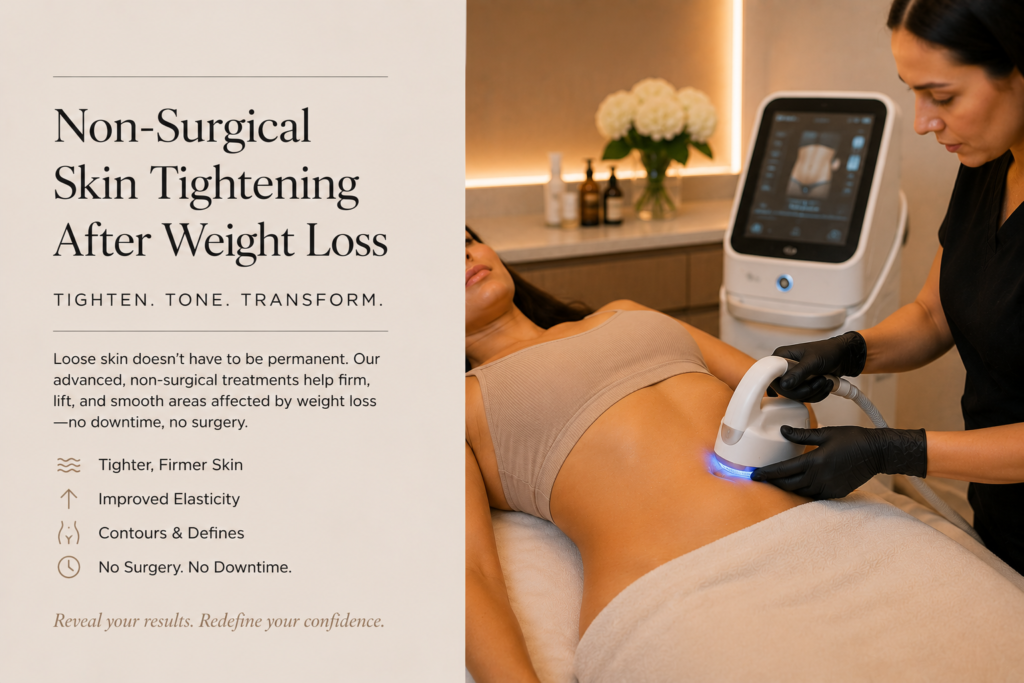
Radiofrequency technology has become the cornerstone of non-surgical skin tightening for very good reason: it works by addressing the root cause of laxity rather than masking it. RF devices deliver controlled electromagnetic energy into the dermis — the deeper layer of the skin — heating it to a precise temperature that triggers a collagen remodeling response. The body interprets this controlled thermal change as a signal to repair and regenerate, producing new, more organized collagen fibers that gradually firm the skin from the inside out. The result is not immediate — collagen remodeling is a biological process that takes weeks to months — but the improvement is real, progressive, and cumulative with a proper series of treatments.
At Luxbae, we’ve built a complete post-GLP-1 restoration toolkit — because we see this exact situation every single week. Renuva, the regenerative adipose matrix available exclusively through elite aesthetic injectors, is one of our most powerful tools for restoring natural volume without surgery. Our InMode EvolveX platform addresses skin laxity and muscle tone simultaneously — reflecting the longevity-focused philosophy of our Medical Director, Dr. Ernst von Schwarz, a world-renowned specialist in longevity cardiology and regenerative medicine. The goal at Luxbae has never been a quick fix; it’s always been intelligent, long-term transformation.
At Luxbae, we use Forma skin tightening for the face, neck, and smaller body areas where precision matters most, and the Evolve platform for larger zones — the abdomen, flanks, inner thighs, arms, and knees. Both devices are backed by clinical data and have become trusted standards of care for post-weight-loss laxity precisely because they address the underlying structural issue rather than the surface appearance alone.
Evolve Body Contouring: More Than Just Skin Tightening
For patients dealing with not just loose skin but also residual fat deposits and muscle laxity after weight loss, the Evolve platform offers something that standard RF cannot: a multi-dimensional approach. Evolve combines radiofrequency skin tightening with electrical muscle stimulation (EMS) to simultaneously address three distinct problems — skin laxity, stubborn fat, and muscle atrophy. This combination is particularly valuable for the abdomen after significant weight loss, where the issue isn’t just loose skin overlying the muscles but also weakened core musculature that contributes to the appearance of a soft, undefined midsection even when body fat is relatively low. The EMS component triggers involuntary muscle contractions that strengthen and tone the muscle, while the RF component firms the overlying skin. It’s the kind of comprehensive remodeling that a single-modality device simply can’t achieve.
One of our clients put it in a way we hear often: she said losing 28 pounds on semaglutide was the best thing she’d ever done for her health, but she felt like she was wearing someone else’s body — her clothes fit perfectly, but the person in photos looked exhausted, almost deflated. The backside she’d always been proud of had completely flattened, and her arms had a softness she couldn’t exercise away. She came in expecting to book one or two treatments and left with a phased plan that over the following four months genuinely completed the transformation she’d started. That combination of body restoration and skin tightening is exactly the gap we built our post-GLP-1 protocol to fill.
Evolve treatments are done in a series of six to eight sessions, typically scheduled twice a week, and results build cumulatively — with the full benefit becoming visible two to three months after the final treatment as the collagen remodeling process completes. Most patients continue seeing improvement for up to six months post-treatment.
Morpheus8 for Deeper Remodeling
When skin laxity is more significant — the kind that comes with losing 50 or more pounds, or with patients in their 40s and 50s whose collagen production is already reduced — Morpheus8 provides a deeper level of remodeling than surface RF alone can achieve. Morpheus8 is a fractional radiofrequency microneedling device that delivers RF energy directly into the dermis and subdermal tissue through a matrix of tiny needles. By bypassing the epidermis and delivering energy at depth, it triggers a more aggressive and targeted collagen remodeling response. The results are meaningfully more pronounced than surface-level RF for patients with significant laxity, making it the right choice for the lower face and jowls, the neck, the abdomen after major weight loss, and the inner thighs. Downtime is slightly more than standard Forma — expect three to five days of redness and mild swelling — but the depth of remodeling it achieves is in a different category.
PDO Threads for Structural Lift
When skin laxity has progressed to visible sagging — jowls that have descended, a neck that’s lost definition, brows that have dropped — PDO thread lifting at Luxbae provides a structural solution that radiofrequency alone can’t replicate. Polydioxanone threads are dissolvable sutures inserted under the skin that physically reposition sagging tissue while simultaneously stimulating a robust collagen response around each thread. The mechanical lift is immediate; the biological regeneration builds over three to six months as the threads gradually dissolve and new collagen fills in along their path. For post-weight-loss patients with mild to moderate jowling, neck laxity, or descended brow position, PDO threads can deliver a meaningful lift without surgery, general anesthesia, or significant downtime. Results typically last 12 to 18 months, and the collagen stimulation they trigger continues to benefit the skin even after the threads themselves have dissolved.
Getting the Sequence Right
One of the most important — and most overlooked — factors in achieving great non-surgical skin tightening results is the treatment sequence. Stacking every available treatment at once isn’t the answer; it can actually lead to suboptimal results and unnecessary expense. At Luxbae, our approach is always to assess each patient individually: the degree and distribution of their laxity, their age and skin quality, their timeline and budget, and how far they are from their goal weight. From there, we build a sequenced plan that layers treatments thoughtfully.
For most post-weight-loss patients, we start with radiofrequency as the foundation, add PDO threads for structural lift where sagging is present, and incorporate microneedling or biostimulator treatments like PRP to address overall skin quality and resilience. The combination of modalities — each addressing a different layer or aspect of the laxity problem — consistently produces more comprehensive results than any single treatment could achieve alone. And because the improvements are gradual and natural-looking, no one in your life needs to know you did anything. They’ll just think you look great.
You’ve done the hard part. Let Luxbae help you finish the transformation.
Schedule Free Consultation
One of our expertly and medically trained team members is always here to help.