
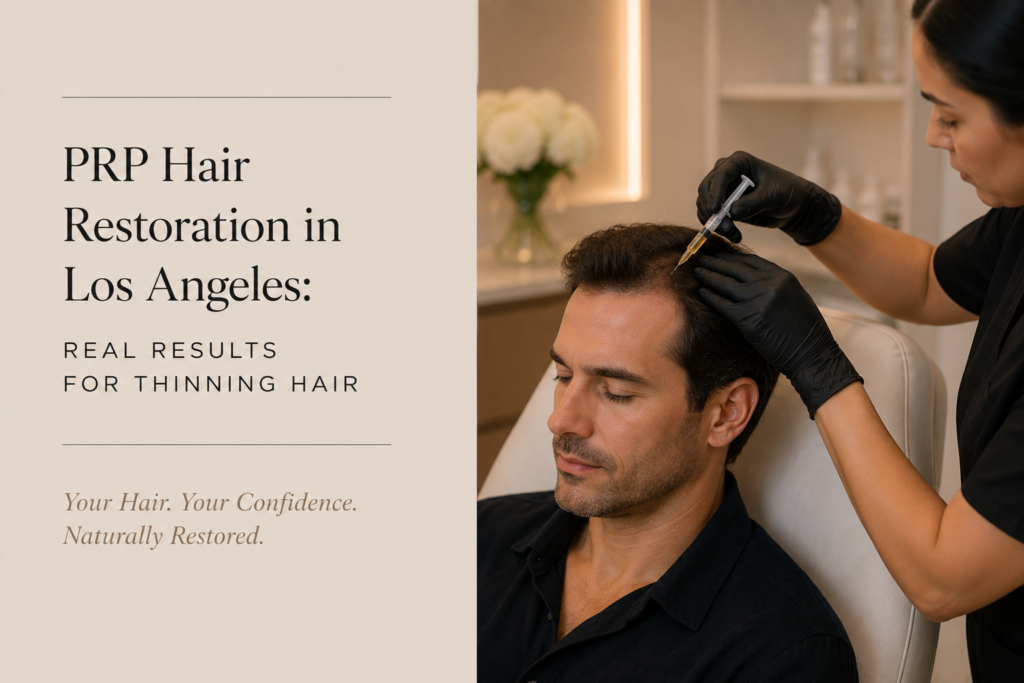
Hair thinning is one of those concerns that tends to arrive quietly and then, suddenly, feels impossible to ignore. You notice it first in the way your hair parts, or the way more strands are on your pillow in the morning, or the way a ponytail that used to feel full now feels thin between your fingers. For both men and women in Los Angeles, where so much of how you present yourself is tied to how you look in person and on screen, hair loss carries real emotional weight. At Luxbae Med Spa in West Hollywood, PRP hair restoration has become one of our most trusted non-surgical treatments — because it works with your body’s own biology to stimulate follicles that are still viable, and for the right patient, the results are genuinely meaningful.
Schedule Free Consultation
One of our expertly and medically trained team members is always here to help. PRP stands for platelet-rich plasma — a concentration of your own blood’s most active healing components. The process starts with a simple blood draw, which is then spun in a centrifuge that separates the components by density. What emerges is a small volume of plasma rich in platelets and their associated growth factors: platelet-derived growth factor (PDGF), vascular endothelial growth factor (VEGF), epidermal growth factor (EGF), insulin-like growth factor (IGF), and transforming growth factor beta (TGF-β), among others. These are the same signaling molecules that coordinate wound healing, tissue repair, and cellular proliferation throughout the body. When injected directly into the scalp at the level of the hair follicles, this concentrated growth factor cocktail stimulates the follicular stem cells — essentially signaling dormant, miniaturized follicles to exit the resting (telogen) phase and re-enter active (anagen) growth. The result, over a series of treatments, is improved hair density, increased shaft thickness, and in many patients, the emergence of new fine hairs in areas that had been visibly thinning.
The Biology Behind PRP Hair Restoration
Who Is the Right Candidate for PRP Hair Restoration?
PRP works best for patients in the early to moderate stages of hair loss — and this distinction is important to understand before you book. The treatment stimulates existing follicles; it cannot regenerate follicles that have been permanently lost. This is why intervention timing matters so much. Patients dealing with androgenetic alopecia (the most common pattern, driven by genetic sensitivity to dihydrotestosterone) in the early to moderate stages — when miniaturized follicles are still present and can be revived — tend to respond best. Women dealing with diffuse thinning often see excellent results, particularly if the thinning is related to hormonal shifts, postpartum shedding, or telogen effluvium triggered by stress or nutritional deficiency. Patients with alopecia areata in early stages may also benefit. The patients who are not good candidates for PRP alone are those with complete follicular absence in bald areas — where the follicles are gone and nothing remains to stimulate. These patients may be better served by considering hair transplantation, potentially with PRP as a supportive treatment to improve graft survival. At Luxbae, we have this conversation honestly during the initial consultation, because the last thing we want is a patient to invest in a treatment that isn’t right for their situation.
The Luxbae team brings the same philosophy to hair that drives everything at our West Hollywood med spa: deep expertise, genuine personalization, and a refusal to apply one-size-fits-all solutions. Every hair consultation begins with an honest assessment of your hair’s actual condition, your styling habits, and your long-term goals — because what works brilliantly for one client can actively compromise another’s hair if applied without careful analysis. It’s the reason so many Luxbae clients trust us with both their skin and their hair.
What a PRP Hair Treatment Session Involves
The process at Luxbae is straightforward and designed to be as comfortable as possible. After the blood draw, the sample is immediately processed in our centrifuge — this takes about 15 minutes. The resulting PRP is prepared for injection. We apply topical anesthetic to the scalp, or in some cases use local nerve blocks for patients who prefer minimal discomfort, then inject the PRP in a systematic grid pattern across the thinning zones using a very fine needle. The full appointment — from blood draw to completion — typically takes 60 to 90 minutes. Most patients experience minimal discomfort and can return to their normal routine the same day, with the standard guidance to avoid vigorous exercise and direct sun exposure for 24 hours afterward.
Some of our hair clients come to us after genuinely damaging experiences elsewhere — a treatment that seemed standard at one salon but destroyed the integrity of their hair for months. One client came in after a keratin treatment applied incorrectly over pre-lightened hair, resulting in significant breakage. After a thorough assessment, we walked her through exactly what had happened and why, built a recovery plan, and set realistic timelines for what her hair could look like in three months versus six. She said the most valuable part wasn’t the treatment — it was that someone finally explained her own hair to her. That level of honest, personalized guidance is what we consider the baseline at Luxbae, not a differentiator.
When Will You See Results — and What Should You Expect?
PRP hair restoration requires patience, and we always make sure patients understand this before they begin. The treatment is not producing results you can see at your one-month follow-up — it’s working at the follicular level in ways that take time to manifest visibly. Most patients follow an initial series of three monthly treatments to load the growth factor stimulus, then transition to a maintenance phase of one treatment every three to six months. The first noticeable changes typically appear at three to four months: reduced shedding first (which is often the first sign patients notice), followed by the emergence of new fine hairs along the hairline and in the thinning zones, and then gradual thickening of existing shafts as the follicular response builds. Full results are generally visible at six to twelve months after starting treatment. It’s a slow process — but it’s a real one, and for patients who stay consistent, the improvement in hair density and quality can be genuinely significant.
PRP as Part of a Comprehensive Hair Health Strategy
At Luxbae, we approach hair restoration the way we approach all aesthetic concerns: by looking at the full picture. PRP is a powerful tool, but it produces its best results in the context of a comprehensive hair health strategy. For patients with androgenetic alopecia, combining PRP with clinically proven medical treatments — minoxidil topically, or finasteride and dutasteride in appropriate candidates — produces outcomes that are meaningfully better than either approach alone. Nutritional optimization matters too: deficiencies in protein, iron, zinc, biotin, and vitamin D are all associated with hair loss, and correcting them creates a better environment for PRP to work in. We assess each patient’s full health picture and make recommendations that span the in-office treatment and everything that supports it at home.
Hair loss has a way of making people feel like they’ve lost something irreversible. The reality for many patients is that the follicles are still there — they’re just underperforming and need the right signal to reactivate. PRP hair restoration at Luxbae is that signal, delivered precisely, scientifically, and with a genuine understanding of the emotional stakes involved. Your hair matters. Let’s talk about what we can do about it.
Schedule Free Consultation
One of our expertly and medically trained team members is always here to help.